How laser cleaning actually works
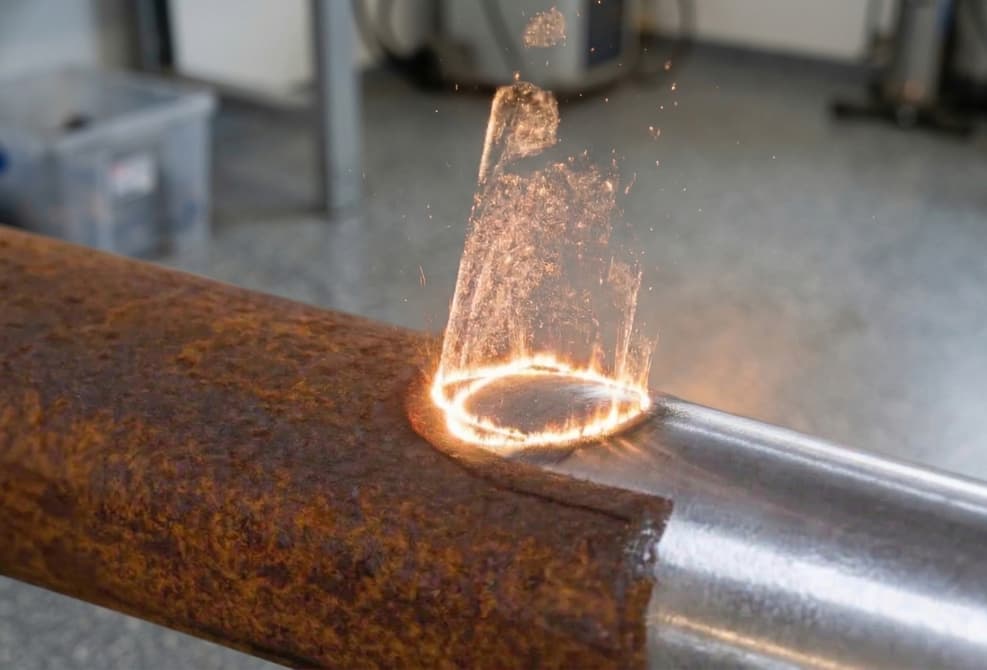
Strip away the marketing for a moment. Laser cleaning is a controlled physical reaction: a beam of light deposits energy at a surface faster than the material can carry it away – and the unwanted layer leaves as a vapour. The substrate, sitting just micrometres below, never has time to notice. This page walks through the physics, the equipment and the on-site procedure we follow on every Swiss intervention.
Energy lands where it's needed.
Rust, paint and oxide absorb the working wavelength far more readily than the metal beneath. Tune the beam correctly and you can lift the top layer cleanly while the substrate barely warms above ambient.
Nothing touches the part.
There is no brush, no media, no chemistry – only photons. Threads, edges and tight geometries that abrasive methods would round off come out unmolested, with their original tolerances intact.
Every pulse is identical.
The system runs to digital parameters – power, frequency, scan pattern. Once a recipe is locked in for your substrate, the next square metre is treated to the exact same finish as the first.
Light is heat – delivered too fast to spread
The beam is a stream of photons, all the same colour, all moving in lockstep. When that stream hits a surface, some of the photons bounce off and some are absorbed. The absorbed ones turn instantly into heat, exactly where they landed – a spot a fraction of a millimetre across.
Now the key trick: we deliver this heat in pulses of around 100 billionths of a second. That is hundreds of times shorter than it takes for heat to diffuse meaningfully into bulk steel. So during the pulse, the temperature spike is trapped at the very top of the surface – typically a layer just micrometres thick.
If that top layer is rust, paint or carbon residue, its temperature rockets past the point where it boils, breaks down chemically, or sublimes directly to vapour. Material leaves the surface as a thin plume of gas and microscopic dust. The base material, sitting one optical absorption depth below, sees a brief warm flicker – often less than the temperature change of being held in a hand.
This is what engineers mean by laser ablation. Not melting. Not burning. A controlled phase change, layer by layer, repeated thousands of times per second until the surface beneath is bare.
Ablation threshold – why the substrate survives
Values are illustrative orders of magnitude – actual ablation thresholds depend on alloy, surface roughness, oxidation history and the specific laser source. The principle holds: there is a wide energy window in which the contaminant is removed and the substrate is not.
What happens in 100 nanoseconds
The threshold window you can see


Drag the handleOne pass separates the oxide layer from the underlying steel without grit, water or solvent.
The five steps of every intervention
Surface survey
We examine the substrate, the contaminant layers and the access conditions. A small witness area tells us which laser parameters will give the cleanest result without compromising the material below.
Parameter recipe
Power, pulse frequency, scan speed and beam pattern are dialled in. The settings sit comfortably between the contaminant's ablation threshold and the substrate's damage threshold – a window we widen by adjusting the optical setup.
Safety perimeter
We delimit the working zone with screens or curtains, equip operators with the appropriate eye protection for the wavelength and connect the fume extractor. The site is now classified as a controlled laser area.
Cleaning passes
The operator runs the beam across the surface in overlapping passes. Heavy deposits may take several passes; light residues clear in one. Real-time inspection confirms when each square is finished – there is no over-spray or wash-down to chase.
Verification
The treated surface is inspected against the brief: bare metal, prepared profile, or layer-selective removal. Captured particulate is bagged and disposed of through certified channels. You receive a written record of what was treated and how.
Six parameters, one clean surface
Wavelength
nmThe colour of the light. Most industrial fibre sources emit in the near-infrared, a region where rust and many paints absorb strongly while clean metal mostly reflects – exactly the contrast we want.
Pulse duration
nsHow long each burst of energy lasts. Shorter pulses concentrate heat at the surface and protect the substrate; longer pulses can deliver more total energy per shot for stubborn coatings.
Repetition rate
kHzThe number of pulses per second. Higher rates spread the energy along the scanned line and increase coverage speed; lower rates concentrate it per spot for thicker layers.
Average power
WThe total energy delivered per second. Bigger numbers move faster, but only up to the point where the substrate's damage threshold becomes the binding constraint – not the contaminant's.
Spot size
mmThe diameter of the beam at the surface. Smaller spots concentrate fluence for precision work; larger spots dilute it for fast cleaning of broad areas. Set by the focus optic in the head.
Scan pattern
mm/sHow the beam is moved across the part – line, raster, zigzag – and how fast. Overlap between adjacent passes governs evenness, and the pattern shape decides how energy is laid down over time.
What the beam can and can't do
| Substrate | Common contaminant | Result | Notes |
|---|---|---|---|
| Carbon steel | Rust, mill scale, paint | Excellent | Bare prepared profile achievable; ideal for re-coating. |
| Stainless steel | Weld oxide, discolouration | Excellent | Restores corrosion resistance without acid pickling. |
| Aluminium & alloys | Anodising, paint, oxide | Care needed | High reflectivity – parameter window is narrow; test patch required. |
| Natural stone & sandstone | Biological crust, soot, urban grime | Excellent | Conservation-grade; patina can be preserved or removed by recipe. |
| Brick & concrete | Smoke, paint, graffiti | Excellent | Selective layer removal, no water ingress, suitable for façades. |
| Hardwood & timber | Old finishes, mould, char | Care needed | Low-power recipes only; demanded for antique restoration. |
| Plastics & composites | Coatings, contamination | Case by case | Many polymers melt or yellow; suitability decided after sample test. |
| Glass | Adhesives, deposits | Not recommended | Risk of micro-fracture; alternative method advised. |
Captured at the head, sealed at the source
The vapour and microscopic dust released by each pulse never wander far. A dedicated extractor sits centimetres from the working zone and pulls the plume directly through high-efficiency filtration. What used to be rust or paint on a surface ends up as a small quantity of dry particulate in a sealed cartridge.
Nothing is rinsed, hosed or washed into a drain. No solvent is consumed. Spent filter media is disposed of through certified Swiss waste channels and a record is kept for every job.
The four-stage capture path
From the working spot to a sealed bag – without a drop of water in between.
- 01 Inline shroud. The cleaning head carries an integrated suction skirt that captures the plume the instant it lifts off the surface.
- 02 Cyclonic pre-separator. Coarse particles drop out first, reducing load on the downstream filters and extending service life.
- 03 HEPA / activated carbon stage. Sub-micron particulate is captured by HEPA media; volatile organics are adsorbed onto activated carbon when the recipe involves paints or finishes.
- 04 Cartridge changeout. Loaded filters are bagged and tracked off-site to a licensed waste handler – closing the loop with documented disposal.
When laser is not the right answer
Very thick paint stacks
Where ten or more layers of marine or industrial paint must be removed across hundreds of square metres in a tight time window, induction stripping or grit blasting can sometimes deliver a faster total throughput. We are happy to quote both and recommend the better fit.
Transparent or low-absorbing materials
Glass, clear polymers and some ceramics pass the working wavelength through without absorbing it. Without absorption there is no heating, and no cleaning. We will tell you in the first message rather than after a wasted site visit.
Heat-sensitive antique substrates
Gilded surfaces, polychrome paintwork and certain organic patinas can be damaged even at low fluence. We will treat these – with conservation-grade parameters and a long testing phase – only when the brief explicitly accepts that pace.
What people ask before booking
Does it leave the surface ready for a new coating?
Yes. The treated surface comes out chemically clean and dry, with a controllable micro-profile. Most coatings can be applied directly, often without an additional preparation step. We can target a specific surface roughness if your specification requires one.
How does it compare to dry-ice or media blasting?
Blasting methods remove material by mechanical impact, which works fast but also wears the substrate and produces secondary waste. Laser removes only the absorbing layer and generates a small volume of dry particulate. For precision work, sensitive substrates and recurring industrial cleaning, the laser route is usually cheaper over the life of the asset.
Is it noisy? Does it disrupt the workshop?
The optical process itself is essentially silent – the noise on site comes from the extractor fan, comparable to a workshop vacuum. There is no compressor, no media line and no spray-pattern overspray, so neighbouring workstations can usually continue operating during the intervention.
What about heat-affected zones?
For correctly parametered cleaning, the heat-affected zone is on the order of micrometres – far below the depth that affects mechanical properties of the bulk material. We adjust pulse duration and overlap to keep that envelope conservative on parts where dimensional stability matters.
How quickly can you cover a square metre?
It depends almost entirely on the layer being removed. Light dust comes off at several square metres per minute. Multi-layer epoxy on rusted steel might run at a quarter of that. We confirm the actual rate during the free on-site demo, on your real surface, before any project commitment.
Do you need a power supply on site?
For most portable units, yes – a standard industrial three-phase outlet is sufficient. For remote sites we bring a generator. We confirm the electrical requirements before the visit so there are no surprises on the day.
See it work on your surface first.
We bring the equipment to your location anywhere in Switzerland, run a sample area on the actual material you need cleaned, and hand you a written estimate before we leave. Typically 30 to 60 minutes. No commitment.
Message us for a free demoAvailable across all 26 Swiss cantons · B2B and heritage projects